Osaka’s Tsuruhashi old commercial world survives through habit, skill and memory, but the people behind the counters, and many of those standing in front of them, are getting older together.
There are places in Osaka that seem designed to be photographed. Tsuruhashi is not one of them, and that may be precisely why I wanted to photograph it. I went there today with Alberto Rossini, an Italian photographer who lives in Osaka and knows the city well enough to look beyond the obvious. We entered the market through one of its narrow passages, and almost immediately the Osaka of glass towers, convenience stores and immaculate department-store food halls disappeared.
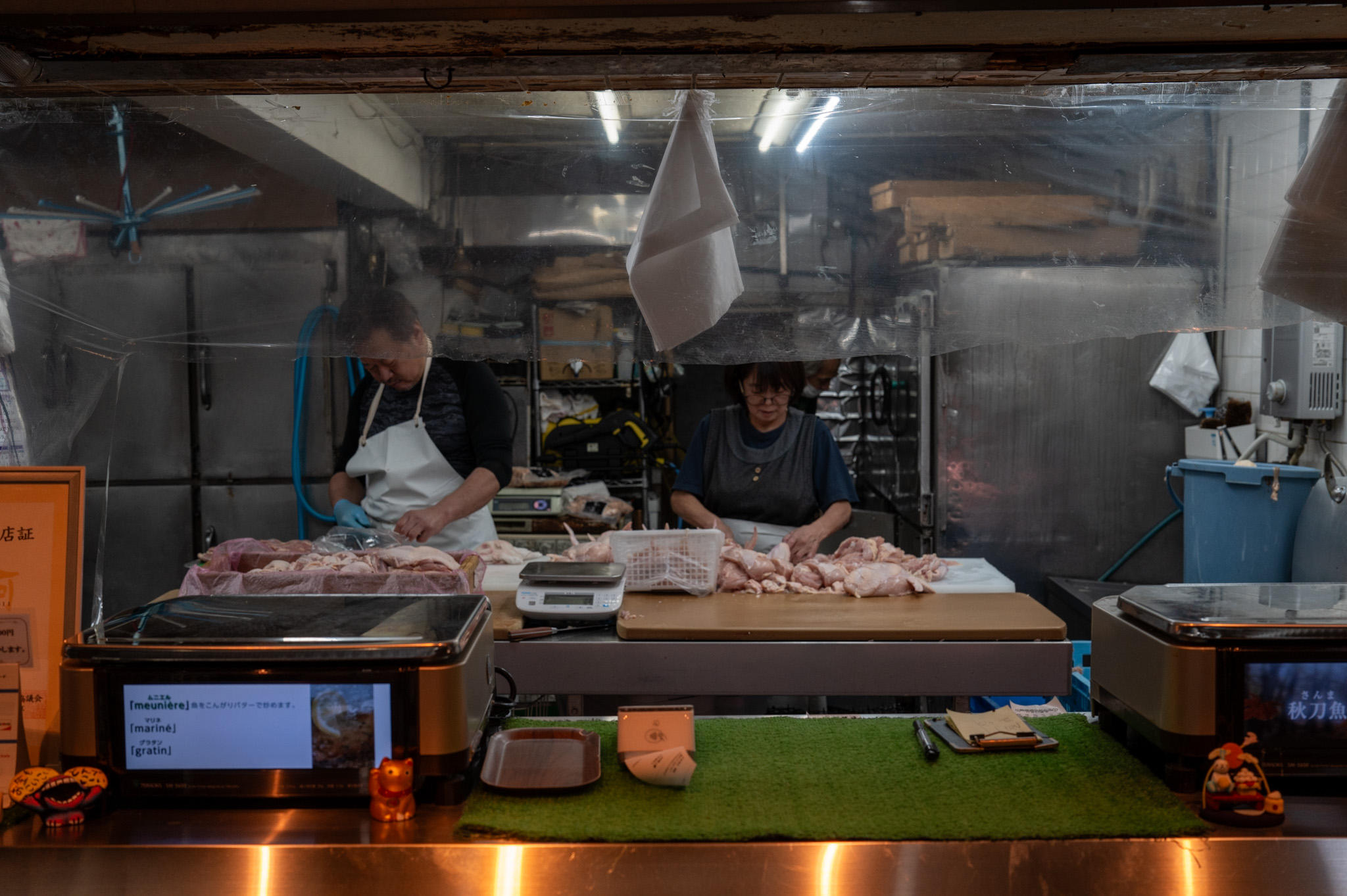
Tsuruhashi is compressed, improvised, slightly chaotic. Fluorescent tubes illuminate worktables. Newspapers hang from walls. Styrofoam boxes are stacked wherever there is space. Plastic curtains separate customers from rooms that are simultaneously shops, kitchens, warehouses and workshops. Knives lie on scarred cutting boards. Bicycles squeeze between shoppers.
The market grew from the informal commerce of the immediate postwar years, around Tsuruhashi Station, where a black market emerged in 1945. By the following years, merchants had begun organizing themselves into the shopping streets that survive today. The wider Tsuruhashi market area eventually became an enormous network of specialist shops selling fish, meat, dried foods, fruit, Korean ingredients and household goods. Yes, we are in “Korea Town”, inside Osaka.
But history is not what struck me most this morning, it was “age”: behind many counters were men and women who appeared to have spent much of their lives there, and standing in front of them were often customers of roughly the same generation.
An elderly woman stops to buy something she has probably bought dozens, perhaps hundreds, of times before. There is little ceremony. No explanation is required. The shopkeeper knows the product; the customer knows what she wants. Money changes hands. A bag is filled. The transaction lasts a minute. Then another elderly customer arrives.
It is an ordinary scene, and also an unsettling one, because when shopkeepers and customers grow old together, who comes next?
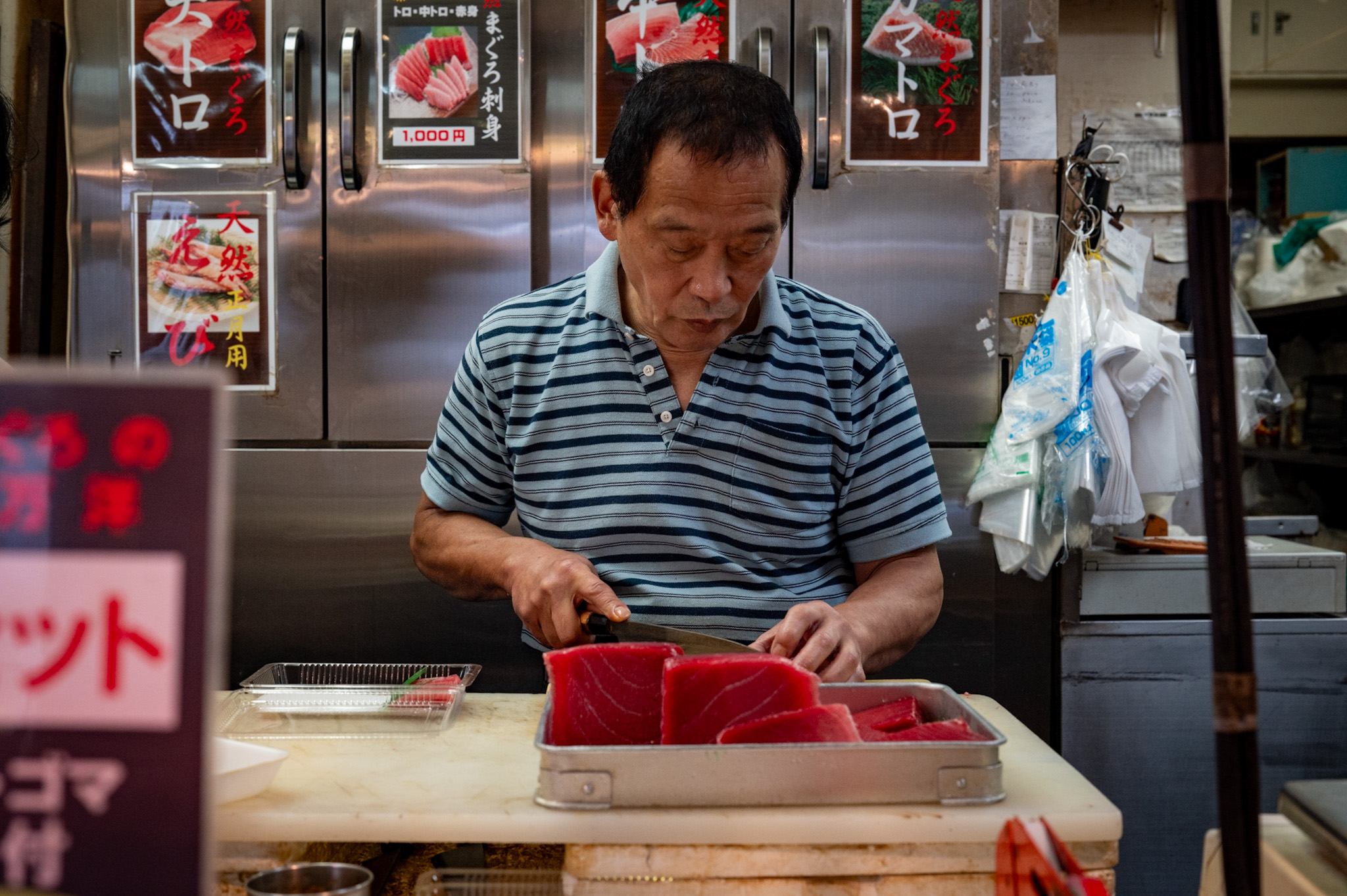
At the fish stalls, work continues with an extraordinary economy of movement. One man bends over blocks of tuna so intensely red they seem almost artificial against the stainless-steel refrigerators behind him. He does not perform for the people passing. His eyes remain on the fish. The knife enters, travels through the flesh and stops. Another piece is separated and placed in a tray.
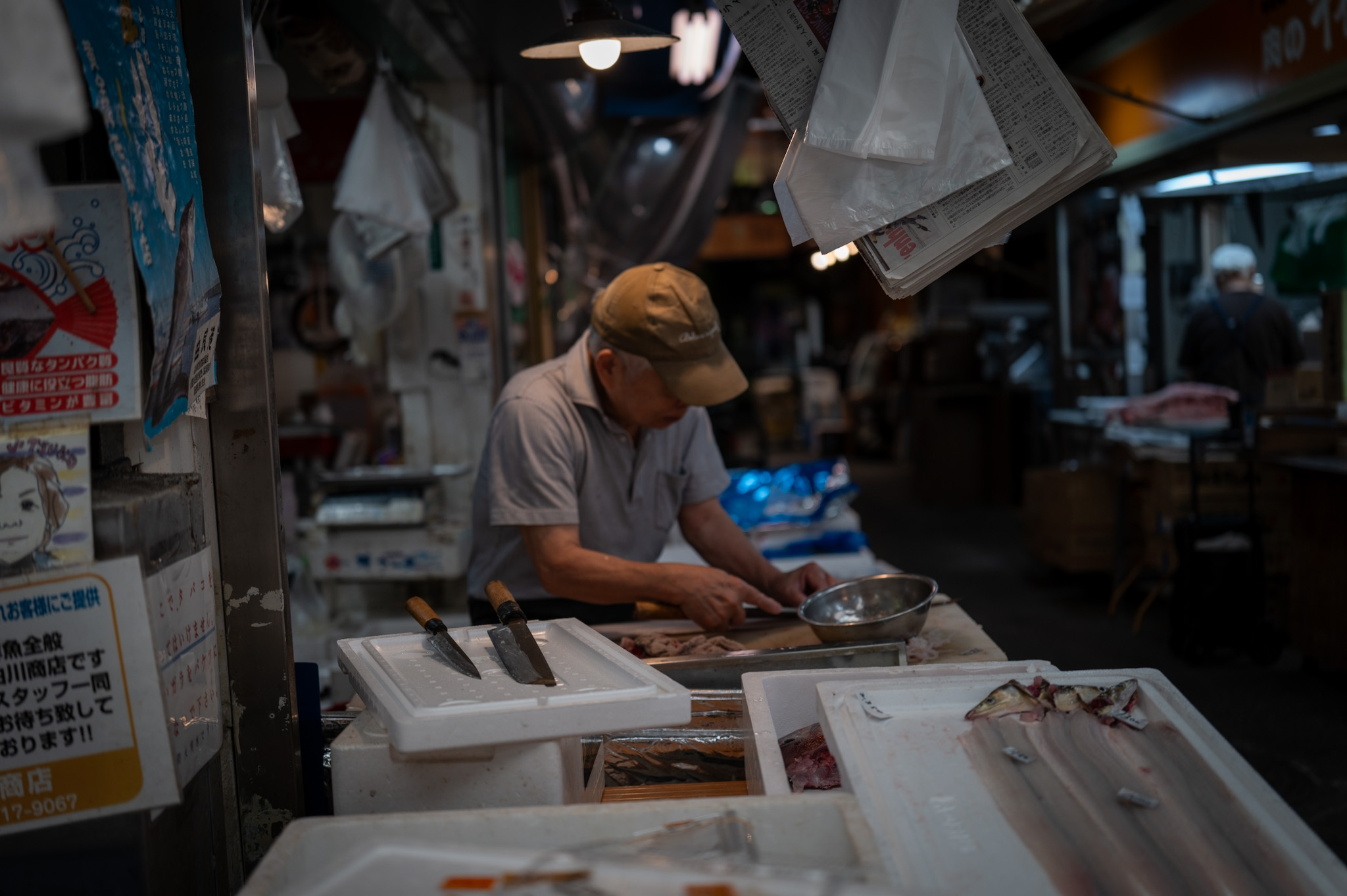
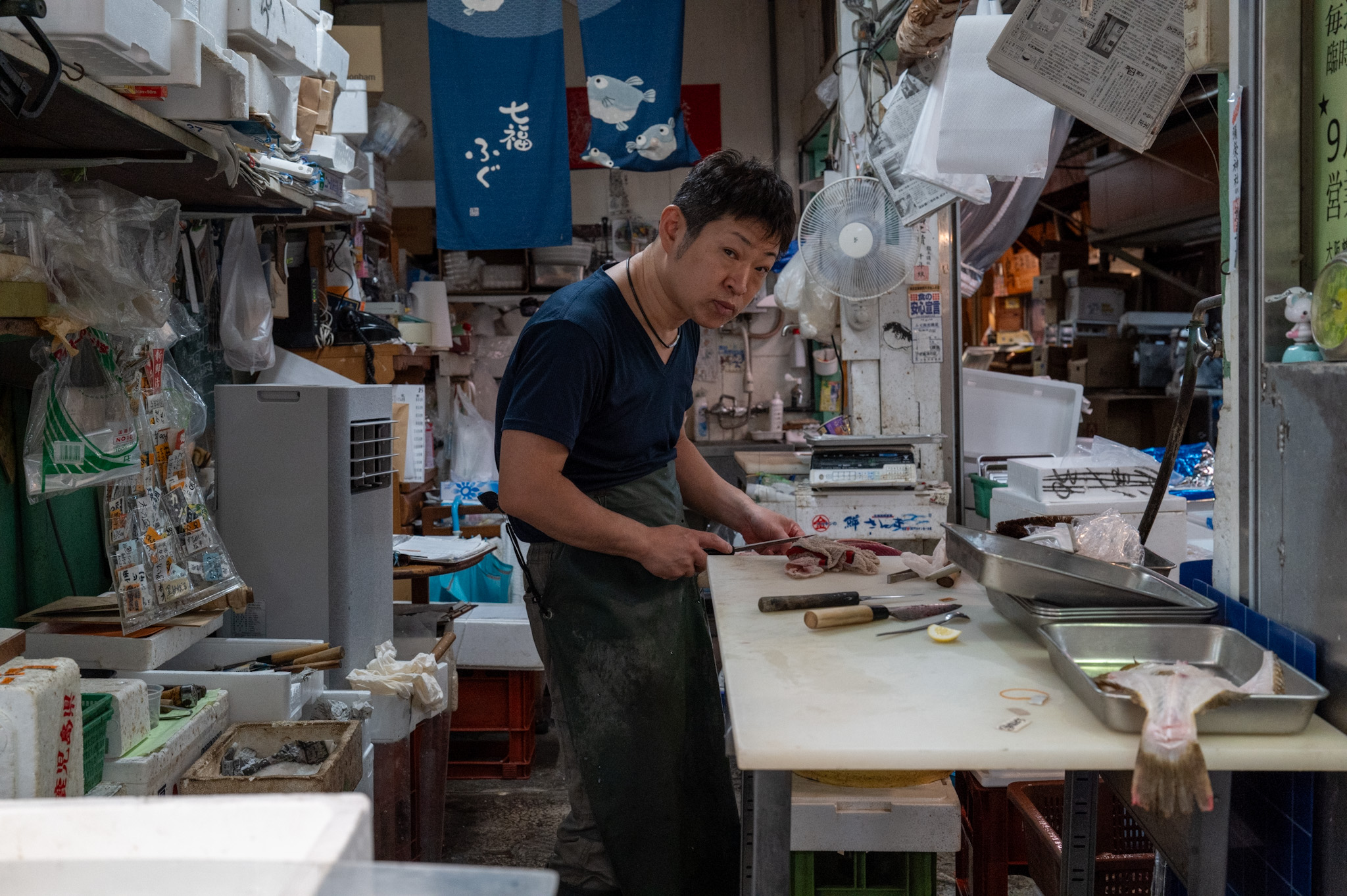
Elsewhere, another fishmonger works at a long white counter surrounded by boxes, trays, plastic bags and tools accumulated through years of use. A fish tail protrudes from a metal tray at the edge of the frame. Above him are newspapers, a fan, pieces of paper and blue noren (the traditional Japanese fabrics divider with vertical slits) printed with fish. Nothing matches, but everything works.
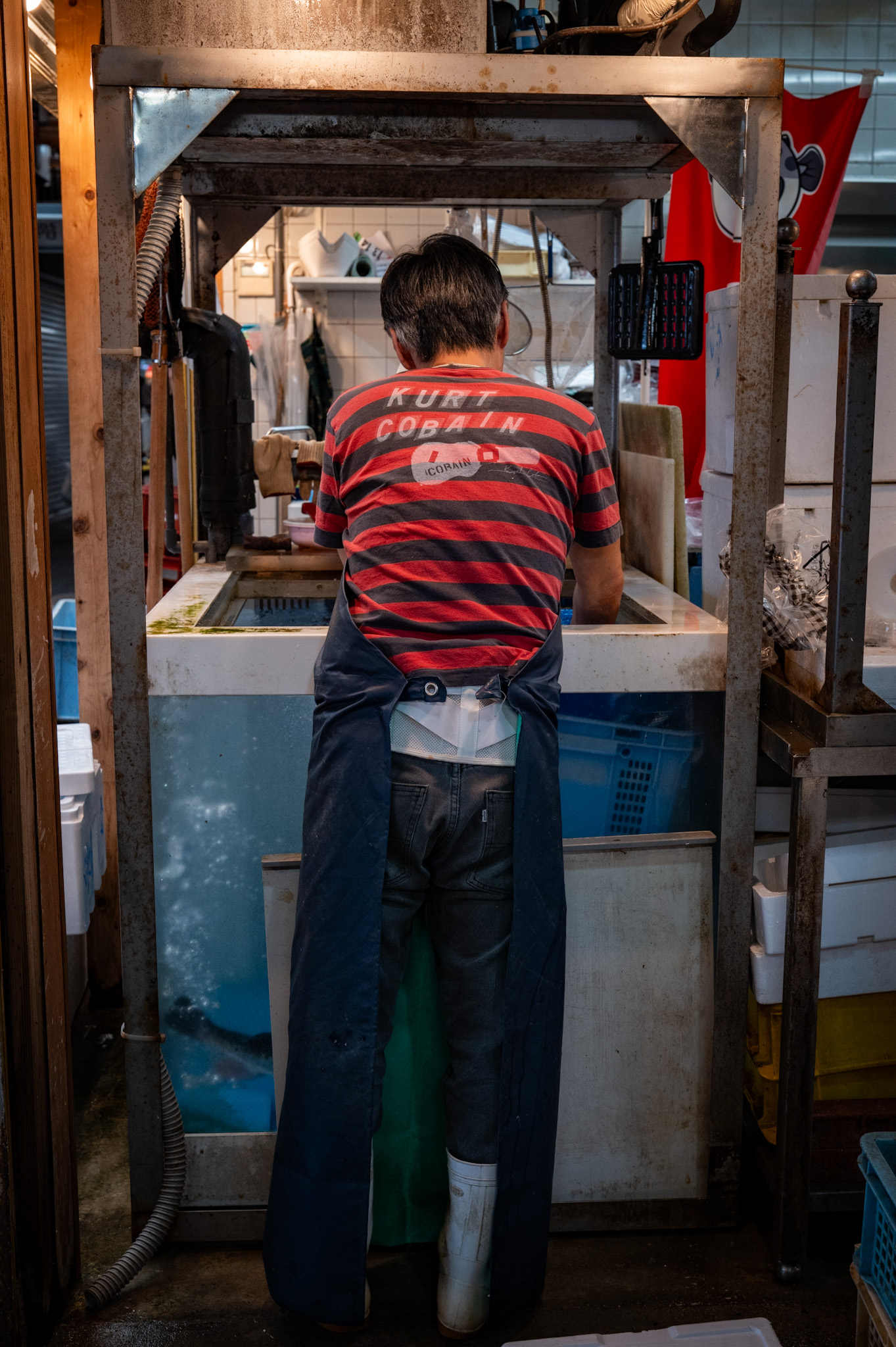
In another stall, a man stands with his back toward the passage, bent over a tank. His apron hangs almost to his ankles, his white rubber boots disappearing into the wet floor below. The metal frame surrounding him has rusted at the joints. It is difficult to tell where the architecture ends and the work begins. These are not picturesque recreations of traditional commerce. They are workplaces.
The official Osaka tourism description still presents Tsuruhashi as a maze of roughly 800 shops across several markets and shopping streets, including specialist stores selling fish, dried goods and everyday provisions. I quote “Professional cooks from Osaka and Kyoto still come to its wholesale fish section early in the morning”, but really cannot see any of them.
Yet walking through the quieter passages, another reality becomes visible. Some shutters remain down. Certain sections feel thinly populated. The density of commerce remains, but the density of people does not always match it. The danger is not simply that shops will close, it is that knowledge will disappear with them.
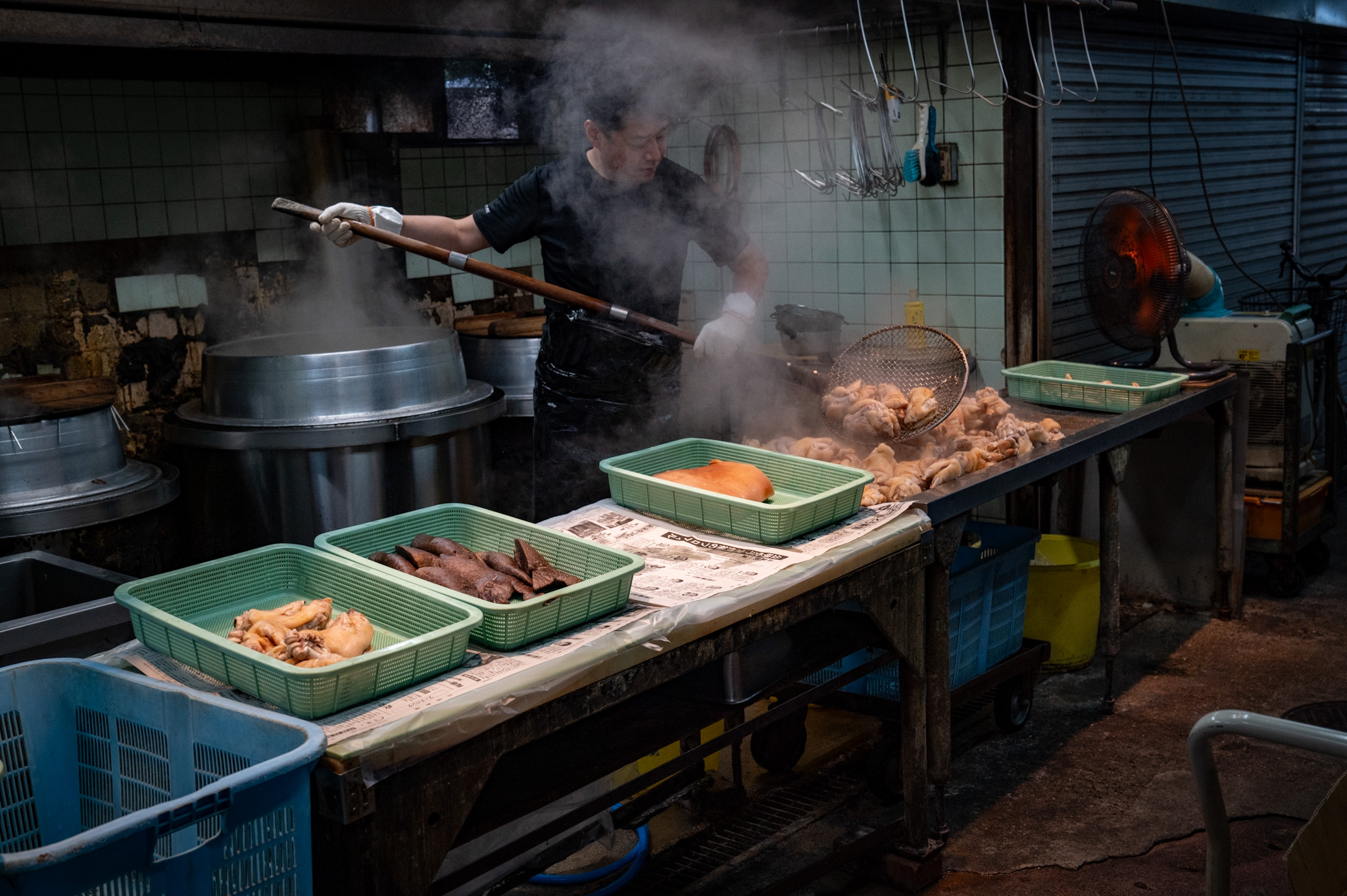
Then there is the steam, deep inside the market, a worker stands beside enormous metal pots, stirring their contents with a wooden pole almost as tall as he is. Pig’s feet are boiling.
Steam fills the small room, temporarily erasing the man’s face before revealing it again. Beside him, green plastic baskets hold the cooked pieces, while newspapers cover the worktable underneath. Metal hooks hang from the ceiling. A battered electric fan points toward the heat. It is a magnificent scene because almost nothing about it appears to have been arranged for an outsider.
The pork is not being cooked behind a stainless-steel wall in an industrial kitchen. The process is visible: water, heat, time, muscle. The huge pots boil relentlessly. The worker lifts the pieces from the water with a large wire basket attached to the long wooden handle, drains them and transfers them to the table. The skin has taken on the pale amber colour of long cooking.
For a photographer, the temptation is the steam, for a reporter, it is the continuity.
Someone learned how long those pig’s feet must remain in those pots. Someone knows when the texture is right without consulting a digital thermometer. Someone knows how to clean them, how to cook them, how to sell them and, importantly, who will buy them. Traditional markets preserve knowledge in this way: not in manuals, but in repetition.
The problem begins when repetition stops.
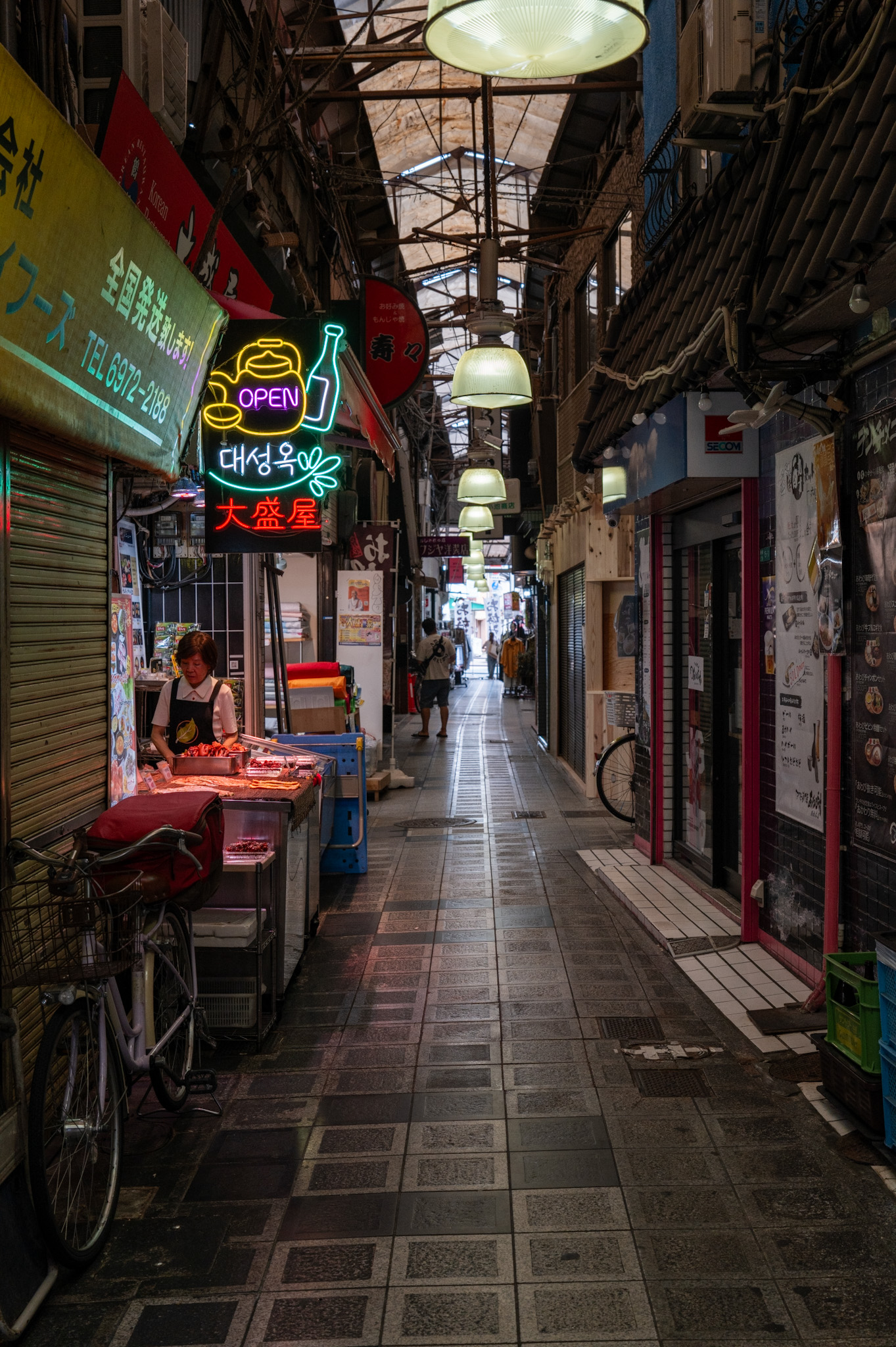
Tsuruhashi is often described through its Korean identity, yakiniku restaurants and the aromas that surround the station. Its history is inseparable from Osaka’s Korean and Korean-Japanese community, while the postwar market developed around one of the city’s most important railway junctions, but the Tsuruhashi Alberto and I walked through today suggested another story.
It is the story of ageing Japan compressed into a few hundred metres of market.
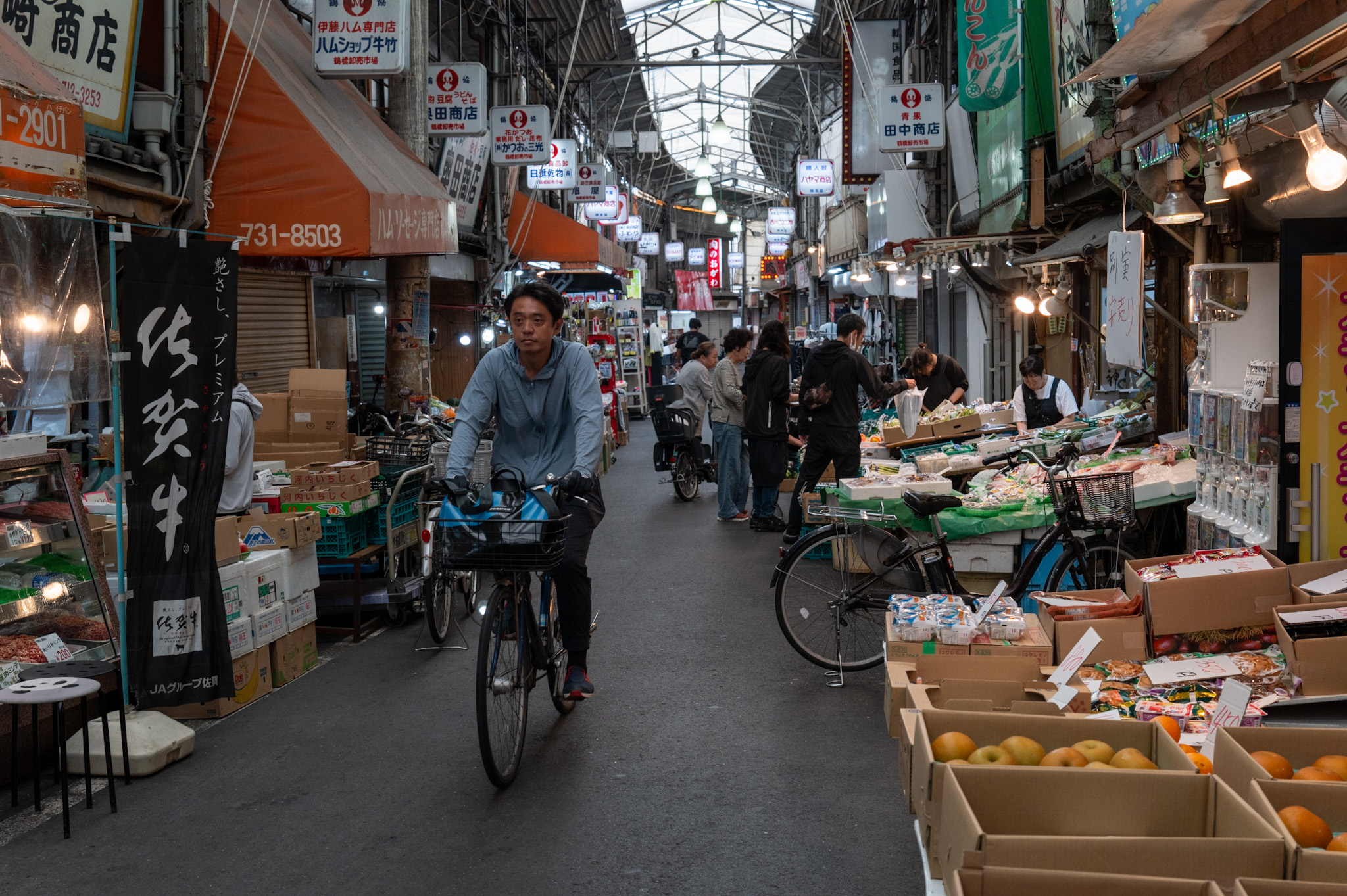
A man rides his bicycle slowly through the arcade while shopkeepers arrange vegetables and boxes along the passage. Older customers stop at stalls where older merchants wait for them. People still come because they know what is sold here, how it should taste and perhaps even which person behind which counter has been preparing it for decades. This is the market’s strength, but it may also be its vulnerability.
A supermarket sells products. Tsuruhashi sells relationships between products, people and memory: when the customer disappears, the shopkeeper loses a market. When the shopkeeper disappears, the customer loses something more difficult to replace: the person who knew how it was supposed to be done.
There is an older account from Tsuruhashi that now feels almost prophetic. In 2012, Osaka Prefecture interviewed an 81-year-old katsuobushi merchant who had begun working in the market at 17. He remembered opening earlier when traditional udon shops were more numerous. As independent restaurants disappeared and chains expanded, his commercial world changed with them, and one morning an enormous pot that has been boiling pig’s feet for decades does not need to be lit.
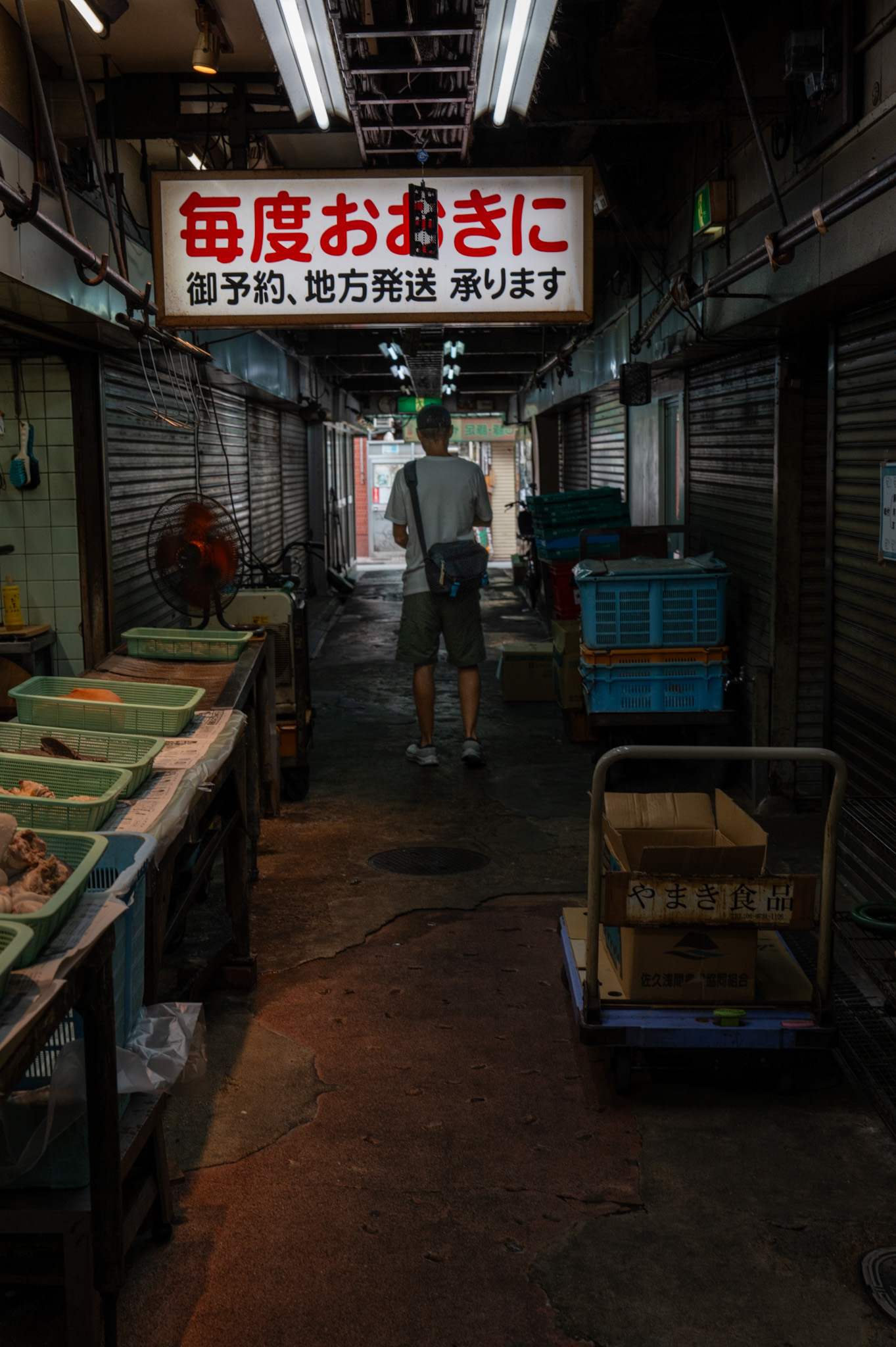
Tsuruhashi remains one of the most atmospheric places I have found in Osaka. Perhaps precisely because it has not yet been cleaned of its imperfections. It smells of fish, pork, water, cooking, cardboard and old buildings. It sounds of knives striking boards, bicycles passing, refrigerators humming and merchants talking across narrow corridors. Nothing about it feels curated.
Walking out with Alberto, I kept thinking that photographing places like this is not really about nostalgia. Nostalgia wants the past to remain unchanged, photography can do something else, it can simply say: this existed, these people worked here, and this was how Osaka fed itself.
Osaka, September 17, 2026. Leica Q3 43.
Discover more from THE QUIET REPORT
Subscribe to get the latest posts sent to your email.
