RICE EXPLODING
Written by Maurizio “Mau” Vagnozzi
There is a peculiar sound in the traditional markets of South Korea that can make an unsuspecting visitor jump. A sudden, almost explosive bang, followed by a thick cloud of white steam rising above the pavement. A few seconds later, everything returns to normal. The customers continue their conversations, the vendors return to their business, and an elderly man bends over a curious metal machine, preparing for another round.
I came across this scene while wandering through one of Korea’s traditional markets, where the older generation still practices trades that have largely disappeared from modern urban life. The machine looked like a small industrial relic: a heavy cylindrical metal chamber mounted horizontally over a burner, surrounded by plastic baskets, bags of grain and the familiar disorder of a working street stall. Nothing particularly sophisticated, at least at first glance. Yet the process it performs is a small demonstration of applied physics.
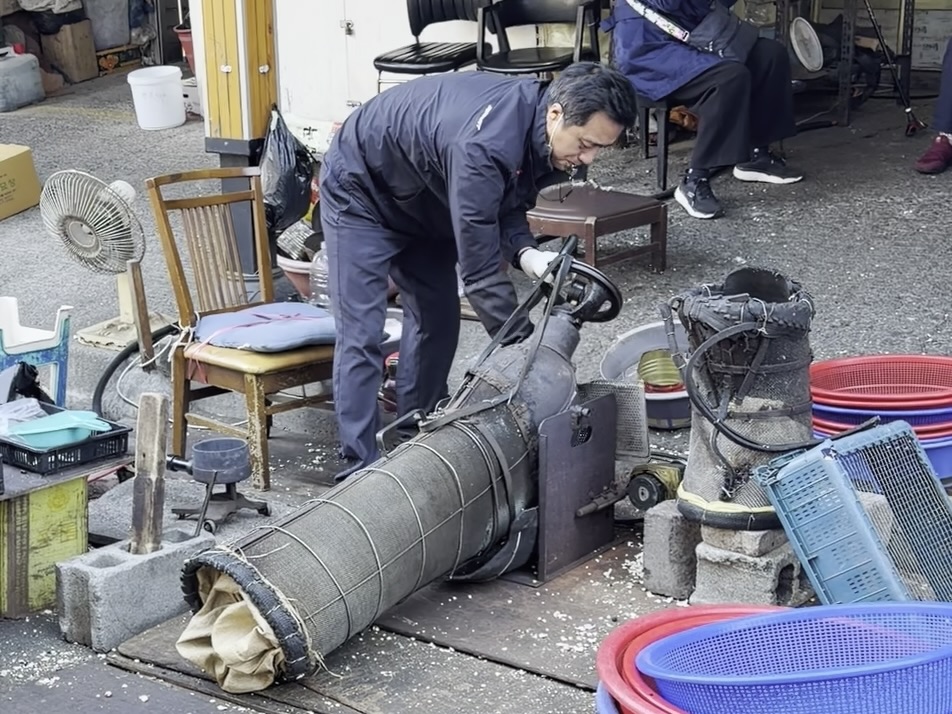

The technique is known in Korea as ppeongtwigi, a name that evokes the explosive sound produced when the machine is opened. Rice, corn or other grains are placed inside a sealed metal chamber and heated while the pressure increases. The combination of temperature and pressure transforms the moisture inside the grains into superheated water and steam. When the operator suddenly releases the chamber, the pressure collapses, the moisture expands almost instantaneously, and the grains puff into light, crunchy snacks.
The entire transformation happens in a fraction of a second. What enters the machine as ordinary grain emerges as something dramatically different, with a new texture, a much greater volume and the distinctive toasted aroma of puffed cereals. The spectacular cloud that accompanies the explosion is mostly steam, mixed with fine particles released during the process.
Pressure-puffing machines became familiar sights in Korean neighborhoods during the decades following the Korean War, when inexpensive snacks made from rice and other cereals were particularly attractive in a country rebuilding its economy. For generations of Korean children, the characteristic bang of the machine was part of the soundscape of everyday life. The snack itself was simple, affordable and made from ingredients already central to the Korean diet.
Similar machines can be found in China, where traditional grain-puffing devices have long been associated with itinerant vendors and neighborhood markets. Across Asia, different variations of the technology reflect the same principle: transforming inexpensive agricultural products into ready-to-eat food through a remarkably efficient mechanical process.
But what interested me most was not the physics. It was the man operating the machine and the small economy surrounding him.
Like so many activities I have been observing in the markets of Seoul, Busan and Gyeongju, this is a business that belongs largely to an older generation. It requires experience, patience and familiarity with equipment that looks increasingly out of place in a country otherwise associated with technological sophistication. The operator knows when the chamber is ready, how to handle its pressure and how to repeat the operation dozens of times during a working day.
There is also something revealing about the relationship between the machine and its customers. In the traditional market, food production remains visible. The ingredients are there, the process takes place in front of everyone, and the final product is collected almost immediately. There is no elaborate packaging, no advertising campaign, no industrial mystery separating production from consumption. The customer can see exactly how an ordinary grain becomes a snack.
Modern Korea, of course, has developed an extraordinary food industry. Convenience stores offer an almost endless selection of packaged snacks, while supermarkets sell industrially produced puffed cereals in perfectly standardized portions. They are cleaner, more convenient and more predictable. But they have also removed the human performance that once accompanied the preparation of food.
Watching the old machine release another enormous cloud of steam, I was reminded of how much of Asia’s traditional economy survives in these small, apparently insignificant activities. A few square meters of pavement, an ageing operator, a piece of machinery that has probably changed very little in decades, and a handful of customers who still appreciate the taste of something made in front of them.
The explosion lasts barely a second. The tradition behind it has lasted generations.
Discover more from THE QUIET REPORT
Subscribe to get the latest posts sent to your email.
